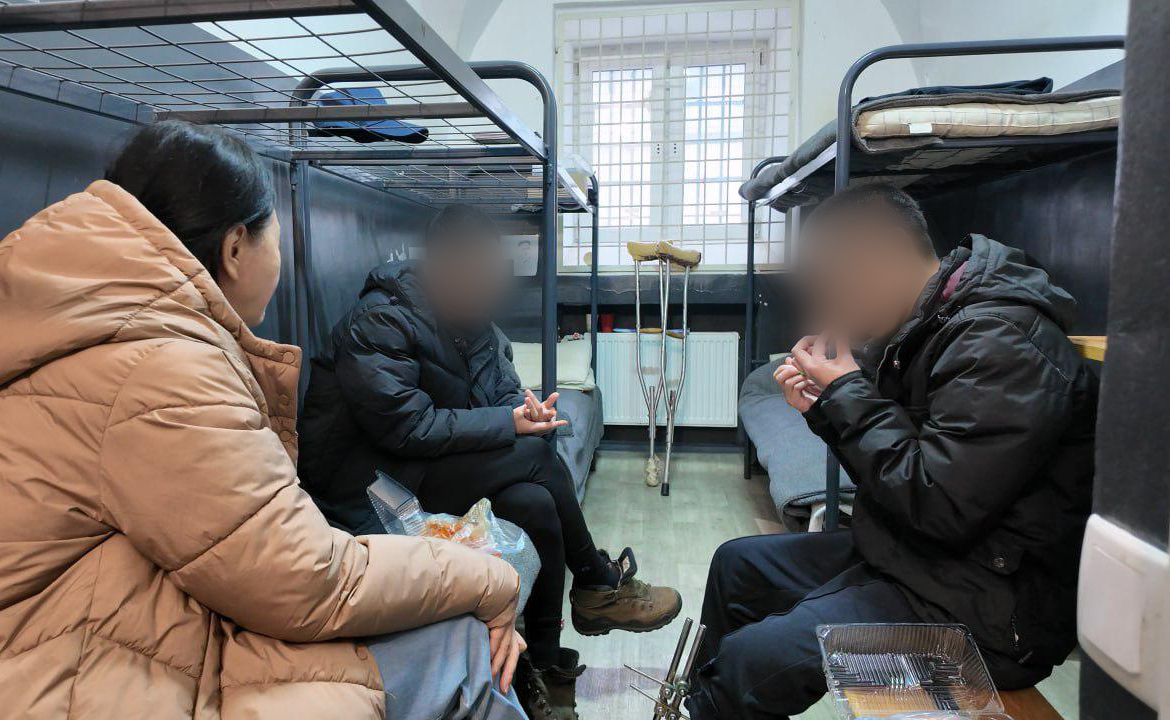
A row over whether Ukraine broke an agreement by disclosing the transfer of two North Korean prisoners of war to South Korea is fueling speculation over why Seoul had hoped to keep the matter confidential.
Last week, Ukrainian President Volodymyr Zelenskyy revealed the transfer during his address to the United Nations General Assembly in New York. Soon afterward, President Lee Jae Myung expressed regret over the disclosure, saying that the two sides had agreed not to publicize the matter.
Cheong Wa Dae on Sunday stepped up its criticism of Ukraine over the disclosure, demanding an official explanation and apology, insisting that the two governments had agreed to keep the transfer confidential.
Seong Ghi-hong, senior presidential secretary for public affairs, said Ukraine had initially requested secrecy during consultations with Seoul, citing the sensitivity of the issue and possible domestic criticism that Kyiv had given up an opportunity to exchange the North Korean soldiers for Ukrainian prisoners held by Russia.
Seoul agreed to confidentiality after considering the safety of the two soldiers and their families, as well as broader diplomatic and security concerns, Sung said.
He accused Kyiv of unilaterally revealing the transfer in Zelenskyy's UN address without sufficient prior explanation or consultation. Sung also strongly disputed a subsequent statement from the Ukrainian presidential office that there had been no confidentiality agreement.
"The Ukrainian government's unilateral disclosure in violation of the agreement is itself a very serious matter," Sung said, adding that Kyiv's subsequent denial of such an agreement "seriously undermines trust between the two governments."
Cheong Wa Dae expressed "strong regret" over Ukraine's handling of the matter, demanded an official explanation and apology, adding that it was considering further measures.
The disagreement has prompted questions over why Seoul placed such importance on keeping the transfer quiet.
One interpretation is that the South Korean government wanted to minimize potential friction with Pyongyang at a delicate moment for diplomacy.
While North Korea has glorified the deployment of its troops in support of Russia and repeatedly doubled down on its nuclear armament, Seoul is hoping to help reopen dialogue between Washington and Pyongyang.
At Lee's summit with US President Donald Trump in New York on Sept. 22, Trump reaffirmed his willingness to engage in dialogue with North Korea, and the two leaders agreed to remain in close communication to help resume US-North Korea talks. Lee also asked Trump to help facilitate the resumption of dialogue with Pyongyang, to which Trump responded positively, according to a Cheong Wa Dae official.
Seoul and Kyiv laid the groundwork for the POWs' transfer months earlier. During Lee's summit with Zelenskyy in July, the two leaders agreed that the issue should be resolved in a manner consistent with international law and humanitarian principles, while respecting the wishes of the individuals involved.
Cheong Wa Dae rejected any suggestion that considerations beyond those stated by the presidential office played a role in its approach.
Some experts say that dialogue with North Korea is unlikely to have been a major factor in Seoul's hopes to keep the matter secret.
Bong Young-shik, a security expert and visiting professor at Yonsei University, said it was unlikely that Seoul's preference for secrecy was intended to facilitate US-North Korea dialogue.
"I think it would be going too far to interpret this as being directly connected to efforts to promote US-North Korea dialogue," he said.
Bong noted that regardless of the dispute over the disclosure Seoul had ultimately accomplished the more consequential task of bringing the two men safely to South Korea.
"The Foreign Ministry and the Lee Jae Myung administration did, after all, ensure that the prisoners, who expressed a desire to defect, were brought safely to South Korean territory," he said. "That was something they handled well."
Cha Du-hyeogn, vice president of the Asan Institute for Policy Studies, meanwhile questioned the logic.
He pointed out that North Korea was likely to find out about the transfer anyway, and raised broader questions over whether avoiding friction with Pyongyang should shape Seoul's approach to dialogue.
"If US-North Korea or inter-Korean dialogue can take place only when we avoid provoking North Korea, wouldn't that ultimately mean entering talks on terms largely dictated by Pyongyang?" Cha said.
"But dialogue itself is not what matters most. What matters much more is what agenda the talks are based on and whether North Korea shows some change in its position."
He also questioned whether keeping the transfer secret could realistically protect the soldiers or their families from possible repercussions in North Korea.
"There could certainly have been purely humanitarian concerns about the prisoners' safety," Cha said, pointing to possible retribution against the soldiers or their families by North Korea.
"But that brings us back to the same question: Is it really reasonable to assume that, simply because Seoul did not publicly disclose the transfer, North Korea would not know about it and therefore would not retaliate against their families?"
Cha, meanwhile, said North Korea itself is unlikely to publicly turn the transfer into a major dispute, because doing so could draw renewed attention to both its deployment of troops to Russia and that the captured soldiers chose South Korea.
"The more North Korea highlights the issue, the more it would serve to remind people of the participation of North Korean troops in the war in Ukraine, so I don't expect it to make a major issue out of it," Cha said.
What could prove more sensitive for Pyongyang, he added, is what the two soldiers may eventually reveal about their experience fighting alongside Russian forces.
"The information that comes from these soldiers could be painful for North Korea," Cha said. "If they provided testimony that North Korean troops were placed in poor conditions or treated as expendable by Russian forces, that could also affect perceptions inside North Korea of the troop deployment."
mkjung@heraldcorp.com

![[Graphic News] Average parental age of S. Koreans rises](https://wimg.heraldcorp.com/news/cms/2026/09/27/news-p.v1.20260927.0bcbf944ca9043c4a6ad4401fcfae25c_T1.gif?type=h&h=800)